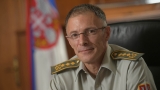

INTERVIEW Of BRIGADIER GENERAL RANKO ZIVAK, SAF AIR FORCE COMMANDER TO POLIIKA DAILY
SERBIA CHOOSES FIGHTER PLANES We have already made requests for additional information from the fourth and fifth generation of plane factories ranging from F-16 and F-18 to Gripen, Suhoy, MiG 29, Eurofighter and Rafale. The commander of the Serbian air force Brig. Gen. Ranko Zivak (45) had long been a flight instructor and a test pilot. He flew all types of home air crafts. Even though his post today entails office work, he still readily enters the cockpit of a plane. ‘Unfortunately”, as he says, “due to a large number of obligations, I can dedicate little time to flying. Flying is my profession, and above everything my love and pleasure. Now there are younger pilots who have to get their number of flight hours. I fly whenever I find the time, on reconnaissance tasks, control and training tasks
SERBIA CHOOSES FIGHTER PLANES
We have already made
requests for additional information from the fourth and fifth
generation of plane factories ranging from F-16 and F-18 to Gripen,
Suhoy, MiG 29, Eurofighter and Rafale.
The
commander of the Serbian air force Brig. Gen. Ranko Zivak (45) had long
been a flight instructor and a test pilot. He flew all types of home
air crafts. Even though his post today entails office work, he still
readily enters the cockpit of a plane. ‘Unfortunately”, as he says,
“due to a large number of obligations, I can dedicate little time to
flying. Flying is my profession, and above everything my love and
pleasure. Now there are younger pilots who have to get their number of
flight hours. I fly whenever I find the time, on reconnaissance tasks,
control and training tasks.
“How many air crafts does the air
force have today as we could recently hear such comments that thee were
more air crafts waiting for an overhaul than the number of functional
planes?”
Currently we have some more than 110 air crafts.
Approximately 70 % of air crafts and helicopter constitute this
resource, the rest is undergoing renewal in cooperation with foreign
partner and overhaul institutes as well as in “Moma Stanojlovic” home
institute for overhauling. It is necessary that the readers make a
distinction between planes and helicopters as resources, and those
resources which are functionally available. The maximum approved expiry
date has to meet two preconditions: the number of flight hours and the
age of the air craft, for instance 30 years and 5000 hours of flight.
If these conditions are met, then we have to dispose of this air craft
and to do general overhaul in order to be able to extend the longevity
of this air craft. Functionality is prone to changes on a daily basis.
Which helicopters and planes, in the long-run, can be used in the future, with or without undergoing overhaul?
Only
training planes utva 75 in the long run cannot be used in the future,
and they will be replaced by lasta 95 types. G-4 and gazelle
helicopters have solid basis for modernization. Other air crafts which
should be used in the period between 2018-2020 are MiG 29 planes, Mi-8
transport helicopters, and two transport planes An-26 until 2015. Orao
and G-4 planes will be kept as their longevity has expired for some
70-80 % but as the precondition of flight hours has not yet been fully
met, it is possible to extend their operational date after 2020. These
planes were constructed here, on the home turf, and we possess all the
construction documentation as well as overhaul capacities. Two Mi-17
helicopters are undergoing overhaul in cooperation with a foreign
partner and by mid 2010 we should have them ready and fully functional.
Mi-8 are also undergoing general repair, while fighter Mi 24 are still
waiting for overhaul. The focus is on repairing transport helicopters,
as transport is our top priority right now, that is, we use these air
crafts on daily basis for SAF needs, and in civil support missions.
What kind of fate will MiG 21 planes meet after being for decades part of our air force?
MiG21
planes will become completely obsolete in the next two to three years
which is why we are carefully and seriously considering the procurement
of a new multi-purpose plane that should replace them. The MoD/SAF team
will be tasked to analyze possible purchases this year. We have already
lodged an information query with six or seven plane factories
specializing in the fourth or fifth generation of planes ranging from
F-16 and F-18 to Gripen, Suhoy, MiG 29, Eurofighter and Rafale. We will
present the analysis early next year and the state will reach a
decision on procurement, as this is a rather complex project requiring
special contracting modules.
How many planes of this type does Serbia need, in view of this military analysis and estimate?
Serbia
needs at least one squadron of multi-purpose fighters-12 to 14.
however, our calculations and estimates suggest that given our future
tasks, we would need some 20 to 24 planes.
What is the average number of flight hours of Serbian pilots?
The
average number of flight hours per a Serbian pilot is the same as last
year’s average number, 25 to 30 hours per pilot. Our mid-term goal is
to increase this number up to 80 to 120 hours per pilot. Regulations
and guidelines suggest that the highest level of capability as a pilot
reaches eight years after graduation, and in this period in order to
attain this level of capability he should have a rather high number of
flight hours, in order to be able to maintain his skills at the top
level, to give his best, both as a pilot and to make use of the
performances of the plane.
Is there a document that defines the number of hours for acro pilots especially days before an air show?
According
to the current methodological manual which we use for planning and
which we strictly abide by, the number of hours per pilot is strictly
defined. For example, in order to train and enable a pilot who flies
orao or G-4 fighter at low or mid altitudes, a pilot has to perform 20
flight that is 7 hours 10 minutes. Of course, a trainee cannot be
trained for acro flying in this period, but for people with already
1000 hours below their belt this is more than enough. Before each air
show we cover the basics of this program, where a pilot must undergo
flight training.