
"Serbian rulers and commanders" exhibition opened
Tuesday, 15.2.2011 | News
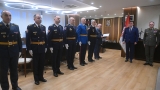
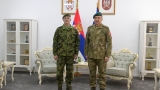
Two big holidays, the Independence Day and Day of the Serbian Armed Forces, which are celebrated on this day was the occasion for the exhibition "The Serbian rulers and military leaders" depicted in the works of renowned Serbian painters, which was arranged in the gallery of the Serbian Army. The exhibition was opened today by the Serbian Chief of General Staff General Miletic Miloje.
Two big holidays, the Independence Day and Day of the Serbian Armed Forces, which are celebrated on this day was the occasion for the exhibition "The Serbian rulers and military leaders" depicted in the works of renowned Serbian painters, which was arranged in the gallery of the Serbian Army. The exhibition was opened today by the Serbian Chief of General Staff General Miletic Miloje.
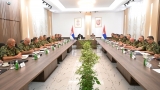
The opening of the exhibition was attended by the representatives of the Ministry of Defense and the Army of Serbia, the figures from the public, cultural and artistic life, and many citizens.
Addressing the audience, General Miletic said that, in the spirit of today's holidays, opened the exhibition "The Serbian rulers and military leaders" announcing it as a cultural event which sends a clear message of the connection of Serbia and its army.
- Modern Serbian state was established in two uprisings, and defended itself in numerous wars. Without the government there would be no army, and no army without the state. Historical circumstances forced our rulers, in addition to state management, to master the art of warfare. This is why it is not surprising why the exhibited portraits of rulers are shown in uniforms, bearing weapons, and some are even depicted fighting alongside soldiers in the trenches - said the Chief of General Staff.
As our country changed, and the society evolved, so the Serbian army underwent numerous changes, as General Miletic reminded. Our troops came from the insurgent troops, he added, becoming one of the best national armies that reached its peak during the reign of Prince Mihailo, but it was King Milan who introduced a standing army modeled after then modern European armies.
- In order to know our future path, we need to know who we are and our origins. What we have been doing in the past last few years involves a process of reform and modernization of the Serbian Army as continuation of the development of defense in modern circumstances, but following in the footsteps of our ancestors- General Miletic said, adding that the Serbian Army has been reformed so that it can respond effectively to security challenges of our time, but is firmly rooted in the Serbian military tradition.
According to him, in the Gallery of the Army of Serbia different principles of the historical significance and artistic merit were applied, as well as cherishing varied military and civic values, tradition and modernity.
- I personally favour famous Serbian commanders from the First World War, where you can sense the merging of military epic and the human fate - admitted Chief of General Staff General Miloje Miletic.
We are able to still show parts that are not represented in the standing museum exhibition, and can be seen only in exhibitions that are organized from time to time, said the author of the exhibition, senior curator of Ljubica Dabic. The works exhibited in today's exhibition are part of the art collection of the Military Museum, and they are represented by historical figures from the 1804 to 1941 said the author, adding that the collection was founded by the former Chief of the Military Museum General Vojislav Vukovic 1934. According to her, today it is a significant art collection, both in number and in quality work within it.
The exhibition includes 32 paintings and four sculptures depicting three parts, and portraits of participants of the First and Second Serbian Uprising, parades and portraits of rulers from the Karadjordjevic Obrenovic dynasties and the third part is devoted to portraits of the Serbian Dukes painted mainly during World War I and II.
The authors of the famous Serbian artists Uros Predic, Stevan Todorovic, Jovan Bijelic and Uros Knezevic, and painters Mihailo Milovanovic, Lukijan Bibic, Nikola Milojevic and Russian artist Vsevolod Guljevic. The organizers of the exhibition are the Media Center "Odbrana” and Military Museum.
The National Day of Serbia, Michaelmas, was also marked by the exhibitions of the symbols of statehood that have been set up in Novi Sad, Nis, Kragujevac and Valjevo. The message of such exhibition is to present the symbols of statehood to the citizens, in a comprehensive way as to point to centuries of building national, constitutional, cultural and artistic tradition in Serbia.
The public will for the first time have the opportunity to see the originals of Serbian constitutions, decorations and medals of the Principality and the Kingdom of Serbia, flags and banners from the time of World War I, and the Serbian royal insignia.
The National Gallery in Nis will until 22 February exhibit the "Serbian flag from the period of the First World War Military Museum in Belgrade. This exhibition includes 51 copies of regimental flags, as well as one original under which the Serbian army had won freedom in the Balkan and First World War. The exhibition presents five original flags of volunteer units from the U.S. and Canada, several medals awarded to the unit for war merits and three certificates of award regimental flag.
The exhibition "The constitutions of the Principality and the Kingdom of Serbia" was opened at the National Museum in Kragujevac until 22 February. Visitors will be able to see six of the constitutions of the period, kept in the Archives of Serbia - Sretenjski constitution from 1835 , the Turkish constitution, which was released in 1838, Governors' constitution of 1869, the Constitutions of the Kingdom of Serbia in 1888, 1901 and 1903.
"Serbian royal insignia of the" organized by the Historical Museum of Serbia, the exhibition is presented to the public in the National Museum in Valjevo, which also is open until 22 February. Royal insignia - the crown, robe, scepter, orb and buckle jacket, are just some of the subjects of great importance for the state and national history of Serbia, which were made for King Peter the First.